Wisconsin Just Lived Through a Historic Week as 23 Tornadoes Including Three EF-3 Monsters With 140 MPH Winds Hit the State in Seven Days Matching an Entire Average Year
MADISON, WI — The numbers coming out of Wisconsin this week are difficult to process — not because they are hard to read, but because they represent something this state has almost never experienced in recorded history. In the span of a single week, 23 tornadoes touched down across Wisconsin, matching the state’s entire average annual tornado count in one seven-day period and delivering a level of destruction that will be studied and discussed for years to come.
Three of those 23 tornadoes were rated EF-3 — producing winds of 140 mph, powerful enough to level well-built homes, throw vehicles hundreds of yards, and strip bark from standing trees. To understand how extraordinary that is: between 2014 and 2025, the entire state of Wisconsin recorded a total of only four EF-3 tornadoes over an eleven-year span. Last week alone produced three.
The Full Breakdown: 23 Tornadoes in One Week
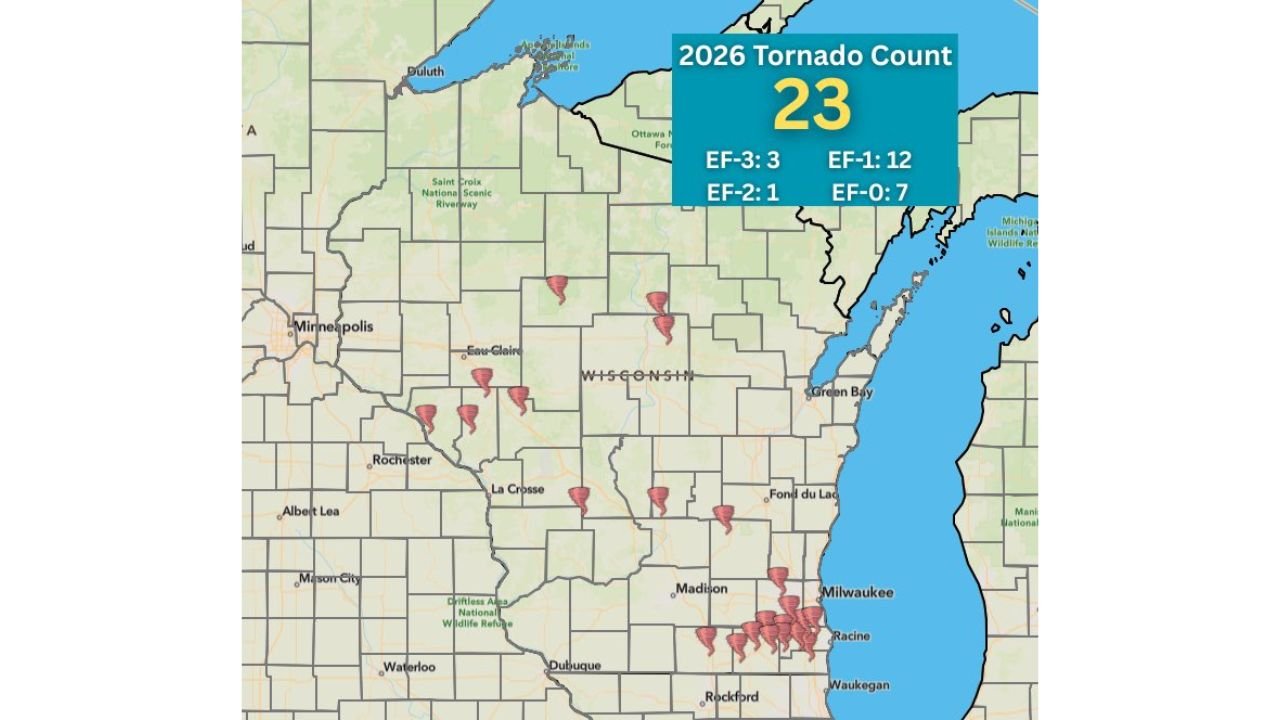
The official 2026 Wisconsin tornado count now stands at 23, all occurring within the same outbreak week. The breakdown by intensity tells a story of a severe weather event that was not just prolific in terms of tornado count but genuinely violent in terms of storm strength:
3 tornadoes rated EF-3 — winds of 136 to 165 mph. This is the violent tier of the Enhanced Fujita scale. EF-3 tornadoes cause devastating damage: entire stories of well-constructed houses are demolished, trains are overturned, and trees are completely debarked. Three of these in one week in Wisconsin is a generational event.
1 tornado rated EF-2 — winds of 111 to 135 mph. Roofs torn off well-constructed homes, mobile homes demolished, large trees snapped or uprooted.
12 tornadoes rated EF-1 — winds of 86 to 110 mph. Roof surfaces peeled off, mobile homes overturned, moving vehicles pushed off roads.
7 tornadoes rated EF-0 — winds of 65 to 85 mph. Light structural damage, tree branches broken, shallow-rooted trees toppled.
Wisconsin Tornado Outbreak: Complete Data Summary
| Rating | Wind Speed | Count | Damage Description |
|---|---|---|---|
| EF-3 | 136 to 165 mph | 3 | Devastating — homes leveled, vehicles thrown |
| EF-2 | 111 to 135 mph | 1 | Severe — roofs removed, trees uprooted |
| EF-1 | 86 to 110 mph | 12 | Significant — roof damage, vehicles pushed |
| EF-0 | 65 to 85 mph | 7 | Light — tree and minor structural damage |
| Total | — | 23 | Entire average annual count in one week |
Where the Tornadoes Struck
The tornado track map shows touch-down locations scattered across a wide swath of Wisconsin, with the heaviest concentration across two distinct corridors.
The western Wisconsin corridor near Eau Claire and extending southward shows multiple tornado symbols clustered tightly together — reflecting the area where the most organized supercell activity produced the densest concentration of tornadoes during the outbreak. The La Crosse area and the counties surrounding it also show significant tornado activity from this western corridor.
The southeastern Wisconsin corridor near Madison, Milwaukee, Racine, and Waukegan shows the second major cluster of tornado tracks — a densely populated region where multiple EF-1 and potentially stronger tornadoes tracked through communities that are not historically accustomed to high-frequency tornado events. The concentration of tornado symbols near Milwaukee and Racine in particular reflects how close this outbreak came to directly impacting some of Wisconsin’s largest urban centers.
Additional isolated tornado tracks are scattered across central Wisconsin near Fond du Lac and the Green Bay corridor, confirming that the outbreak was not confined to a single geographic zone but affected communities across a broad diagonal from the northwest to the southeast of the state.
Why This Week Stands Apart in Wisconsin History
Wisconsin averages approximately 23 tornadoes per year across all seasons combined. The state recorded that entire expected annual total in approximately seven days during last week’s outbreak sequence. In any given normal year, those 23 tornadoes would be spread across spring, summer, and early fall — arriving as individual events separated by weeks or months, allowing communities time to recover between storms.
Last week offered no such spacing. The atmospheric setup that drove this outbreak — the same warm front and explosive supercell environment that was flagged in advance forecasts across the Upper Midwest — delivered its full annual allotment of tornadoes in a compressed and violent burst.
The three EF-3 tornadoes alone rewrite the recent history of violent tornado events in Wisconsin. Having previously recorded only four EF-3 tornadoes in eleven years between 2014 and 2025, the state experienced 75% of that eleven-year EF-3 total in a single week.
Forecast Confidence on the Record
This is confirmed observational data, not a forecast. The 23 tornado count, the EF-3 ratings, and the 140 mph wind speeds associated with the strongest storms are verified assessments from official damage survey teams. These numbers represent the documented meteorological record of what occurred across Wisconsin last week and will stand as part of the state’s permanent severe weather history.
More tornado outbreak and severe weather record coverage is always on the horizon. Stay informed at ChicagoMusicGuide.com — your source for tornado tracking and outbreak documentation across Wisconsin, the Upper Midwest, and the entire United States.