Surface Low Tracking Across Florida Could Bring Severe Storms and Heavy Rain to the Drought-Stricken Peninsula by Sunday May 3
ORLANDO, FL — A developing weather system is on the radar for Florida — and for a peninsula that has been baking under drought conditions, what is coming could be a double-edged sword. Current model data is tracking a surface low pressure system forming over the Florida Peninsula and tracking across the state around Sunday, May 3 into Monday, May 4, 2026. Out ahead of it sits a very hot and humid airmass that is more than capable of fueling severe thunderstorms and heavy rainfall across a broad swath of the state.
For drought-stricken communities across central and south Florida, rain is welcome. The question is whether it arrives organized and beneficial — or severe and destructive.
What the Model Data Is Showing at Day 7
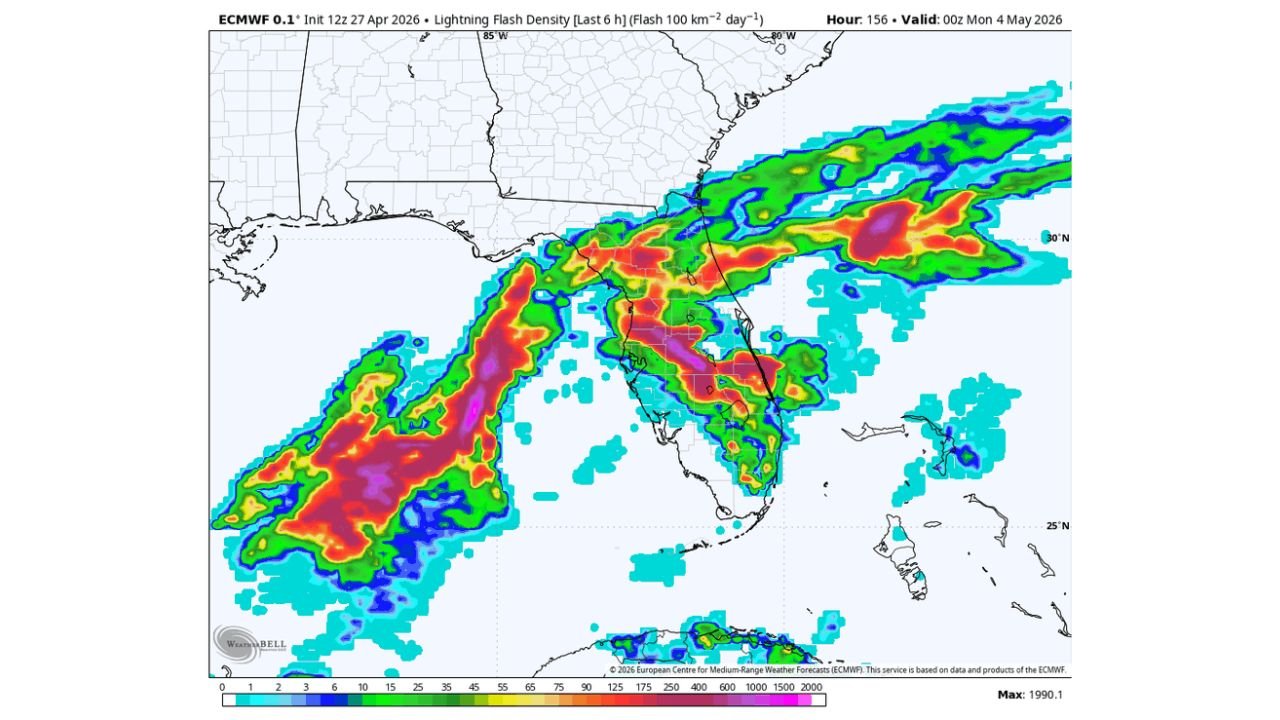
Latest model data initialized April 27, 2026 at 12Z, valid for 00Z Monday, May 4, shows three converging atmospheric signals that paint a consistent and increasingly credible picture of a significant weather event for Florida and the broader Gulf Coast region.
The lightning flash density output — a model-derived estimate of where thunderstorm electrical activity will be most concentrated — shows an intense corridor of deep convection draped directly across the Florida Peninsula from the Tampa Bay area through Orlando and northward into north-central Florida and the Panhandle. The highest flash density values on the map, shown in deep red and magenta, are centered over central Florida and extend eastward across the state toward the Atlantic Coast. A second intense convective corridor stretches well to the west across the Gulf of Mexico, indicating the broader scale of the storm system. Flash density values in the core zones are reaching into the 400 to 1,500+ flashes per 100 square kilometers per day range — an extreme level of electrical activity associated with deep, intense thunderstorm cores.
The Low-Level Wind and Moisture Setup
The 925-millibar wind analysis — which shows atmospheric conditions at roughly 2,500 feet above the surface, a critical layer for storm organization — reveals a focused low pressure circulation centered over the Florida Peninsula at the valid time. The orange and amber shading over central Florida and along the northern Gulf Coast indicates the core of the low-level circulation and its associated wind maximum. Winds in this layer are converging into the circulation from multiple directions, which is the mechanical process that forces air upward and drives storm development.
Current analysis of Integrated Vapor Transport — a measurement of how much atmospheric moisture is being carried through the atmosphere per unit of time, expressed in kilograms per meter per second — shows a powerful atmospheric moisture river aimed directly at Florida. The orange and red values centered over the Florida Peninsula on the IVT map indicate moisture flux values in the 800 to 1,000+ kg per meter per second range. This is the atmospheric equivalent of pointing a firehose at the state. When this level of moisture transport combines with a surface low and an unstable airmass, the rainfall totals can be significant and the storm environment becomes very supportive of organized convection.
Two Models, Two Different Intensities
Current model comparison shows meaningful differences in how aggressively this system develops. The more robust of the two primary global model solutions is depicting a stronger surface low, higher lightning flash density values, and a more organized severe weather setup for Florida on Sunday. The more conservative solution still produces significant rainfall and thunderstorm activity but with a less defined surface low and lower severe weather potential.
This spread between the two solutions at a 7-day range is normal and expected. What is notable is that both solutions agree on the fundamental setup — a surface low tracking across Florida, a hot and humid airmass in place ahead of it, and widespread rainfall for the drought-stricken peninsula. The disagreement is over intensity, not occurrence.
Model Data Comparison Table
| Parameter | Conservative Solution | Robust Solution | Agreement |
|---|---|---|---|
| Surface Low Formation | Weak, poorly defined | Well-organized over FL Peninsula | Both show low tracking FL |
| Lightning Flash Density | Moderate — scattered storms | Very high — 400 to 1500+ fl/km2/day | Both show convection over FL |
| Low-Level Wind Max (925mb) | Light convergence | Strong circulation, amber core | Both show convergence over FL |
| Moisture Transport (IVT) | 600 to 800 kg/m/s | 800 to 1000+ kg/m/s | Both show moisture river into FL |
| Severe Weather Potential | Low to marginal | Moderate — watch worthy | Uncertain — depends on low strength |
| Rainfall for Drought Areas | Moderate coverage | Widespread significant rain | Both favorable for drought relief |
| Valid Time | 00Z Mon May 4, 2026 | 00Z Mon May 4, 2026 | Same valid period |
Area-by-Area Florida Outlook
Central Florida (Orlando, Tampa Bay, Lakeland) — Sits directly inside the highest lightning flash density zone and at the core of the moisture transport corridor. This is the highest-risk area for both severe thunderstorms and the heaviest rainfall totals if the more robust model solution verifies. For a region under drought conditions, meaningful rainfall appears likely regardless of whether severe weather develops.
North-Central Florida (Gainesville, Ocala) — Within the primary convective corridor. Storm activity associated with the surface low track will impact this area. Heavy rain and embedded severe thunderstorms are possible.
Florida Panhandle — The model data shows convective activity extending into the Panhandle corridor, with lightning density values elevated across this zone. Storm timing here will depend on how the surface low tracks across the state.
South Florida (Miami, Fort Lauderdale, Naples) — On the southern fringe of the primary convective zone. Rainfall is possible but the heaviest activity appears focused farther north along the low track. Still within the broader moisture transport plume.
Georgia and Southeast Alabama — The northern extension of the convective corridor in the lightning density data reaches into southern Georgia. Rainfall and storm activity possible on the northern fringe of the system.
Forecast Confidence
At a 7-day forecast range, confidence in the specific details of this system is LOW to MODERATE. What carries HIGH confidence is that a surface low will influence Florida around Sunday into Monday, that the airmass ahead of it is hot and humid enough to support severe thunderstorms, and that widespread rainfall is likely for the drought-stricken peninsula. Confidence in the severe weather potential specifically is LOW to MODERATE and heavily dependent on how organized the surface low becomes as it approaches. The more robust model solution warrants close monitoring. Confidence will increase significantly with each model run over the next several days.
Florida residents — particularly those in drought-affected communities — should begin monitoring this system closely. The rain is coming. Whether it brings severe weather with it is still being decided by the atmosphere.
More severe weather coverage is always on the horizon. Stay informed at ChicagoMusicGuide.com — your source for tropical system tracking, severe storm analysis, and breaking weather coverage across Florida and the entire United States.