
Michigan, Ohio, Pennsylvania, and New York See Far Above-Normal Snowfall While California, Nevada, and Colorado Face Historic Snow Deficits
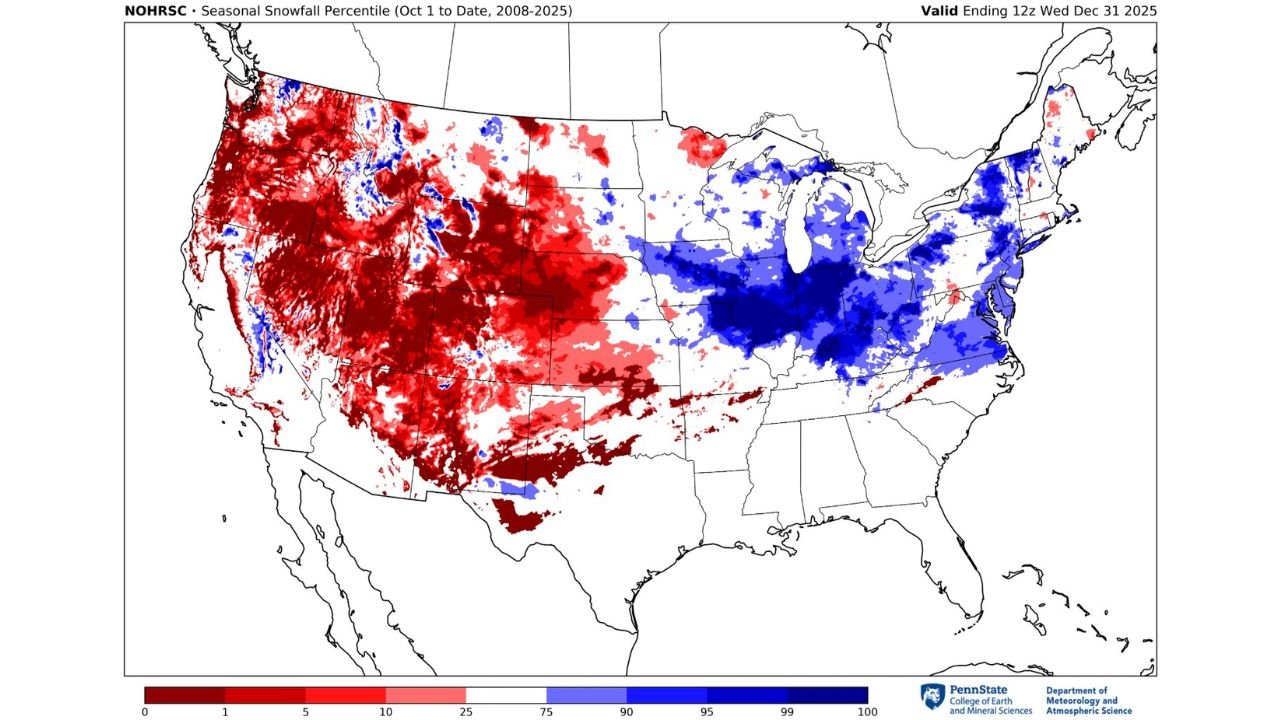
UNITED STATES — Updated seasonal snowfall data through December 31, 2025, reveals a dramatic winter imbalance across the United States, with Michigan, Ohio, Pennsylvania, and New York experiencing significantly above-normal snowfall, while California, Nevada, Colorado, and much of the Western U.S. remain far below seasonal averages. The contrast highlights one of the most uneven starts to winter seen in recent years.
The snowfall percentile map, based on records from 2008 through 2025, compares current snowfall totals since October 1 to historical averages, clearly showing which states are seeing an unusually active winter — and which are struggling to see snow at all.
Michigan, Ohio, Pennsylvania, and New York Among the Snowiest States So Far
The Great Lakes and Ohio Valley region stands out as the snowiest part of the country relative to normal. Large portions of Michigan, Ohio, Pennsylvania, Indiana, and New York are running in the 90th to 99th percentile for seasonal snowfall, meaning these areas have received more snow than most years at this point in winter.
Persistent lake-effect snow off Lakes Superior, Michigan, Erie, and Ontario has driven much of this surplus. Repeated cold air intrusions have allowed snow to accumulate efficiently, producing deeper snowpack and more frequent winter weather impacts across the region.
Interior Northeast Continues to Outperform Seasonal Snow Averages
Beyond the Great Lakes, the interior Northeast — including upstate New York, northern Pennsylvania, Vermont, New Hampshire, and interior Massachusetts — is also running well above normal snowfall levels. Many of these areas appear in deep blue shading on the map, indicating exceptionally snowy conditions compared to historical norms.
This trend reflects a pattern favoring colder storm tracks, allowing precipitation to fall as snow instead of rain during multiple systems.
Central Plains Show Mixed Snowfall Results
The central Plains states, including Iowa, Missouri, Nebraska, and Kansas, show a more mixed picture. Some areas are near seasonal averages, while others remain modestly below normal. Storm systems have frequently tracked eastward toward the Great Lakes rather than spreading snowfall evenly across the central U.S.
California, Nevada, Colorado, and the Western U.S. Lag Far Behind
In sharp contrast, the Western United States is dominated by well-below-normal snowfall, particularly across California, Nevada, Oregon, Washington, Idaho, Utah, Arizona, New Mexico, Colorado, and Wyoming. Many of these regions are shown in the lowest snowfall percentiles, with some areas approaching historically low snow totals for this stage of winter.
Mountain snowpack across the Sierra Nevada and Rocky Mountains remains significantly underperforming, raising concerns about water supply, spring runoff, and long-term drought conditions if the pattern does not shift.
Why This Snowfall Divide Is Important
This early-season snowfall imbalance has wide-ranging impacts. In Michigan, Ohio, Pennsylvania, and New York, above-normal snow increases travel disruptions, infrastructure strain, and snow removal costs. Meanwhile, in California, Nevada, and Colorado, persistent snow deficits threaten reservoir replenishment and long-term water availability.
Meteorologists note that while winter is still ongoing, recovering from large snowfall deficits becomes increasingly difficult as the season progresses.
What Comes Next for Winter 2026
A future shift in the jet stream could still bring snow to western states, but current trends favor continued storm activity across the Great Lakes and Northeast. Until that pattern changes, regional contrasts are likely to remain one of the defining features of this winter.
As winter continues to unfold across the country, snowfall trends are shaping daily life very differently depending on location. ChicagoMusicGuide.com will continue tracking major weather patterns and their impacts across the United States throughout the season.